

Ensconced and Excluded: Jane Eyre Chapter 1
A Jane Eyre Readalong and Teachalong

Jane Eyre’s subtitle is “An Autobiography.” Initially published under a male pseudonym, Currer Bell, the reader is led to believe—even if just for a little while—that this novel is actually non-fiction.
“Wicked and cruel boy!” I said. “You are like a murderer — you are like a slave-driver — you are like the Roman emperors!”
I had read Goldsmith's History of Rome, and had formed my opinion of Nero, Caligula, &c. Also I had drawn parallels in silence, which I never thought thus to have declared aloud. —Charlotte Brontë, Jane Eyre (Chapter 1)
Jane Eyre is introduced in Chapter 1 of Charlotte Brontë's novel as excluded from her aunt and cousins, who are ensconced by the fireside in the adjacent room. Jane has not been allowed to join them until she acquires a “sociable and childlike disposition,” which she is somehow expected to do on her own.
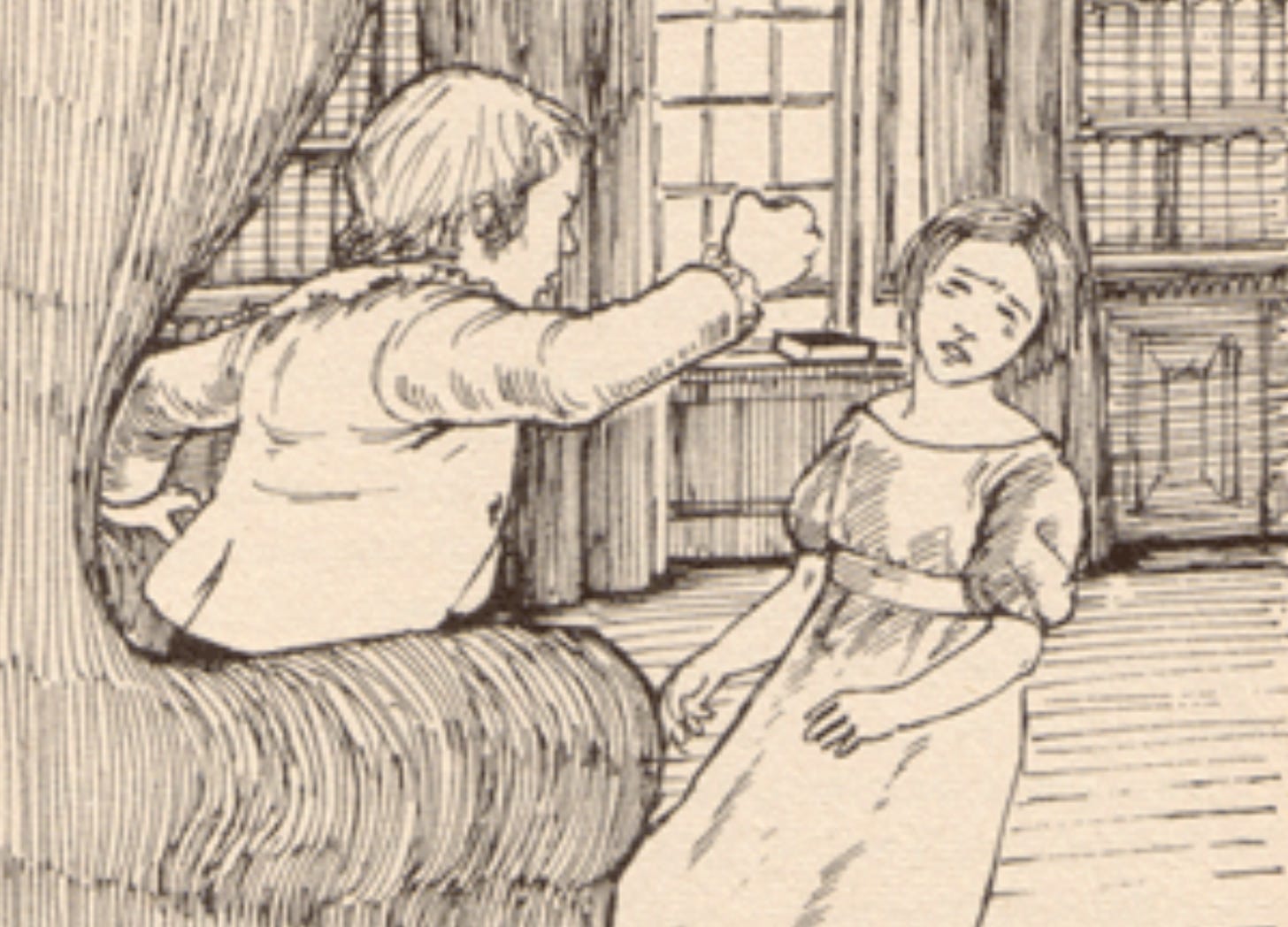
Alone, Jane creates a cozy space to sit. However, instead of surrounding herself with the comfort of flames, she “draw[s] the red moreen curtain nearly close,” and is “shrined in double retirement.”
Brontë twice mentions the color of the curtains: “red moreen curtain” and “[f]olds of scarlet drapery.” This does two things. It complements the image of warmth conjured by a family clustered around a fireplace. And it foreshadows the Jane's visceral encounter with red in the next chapter.
Accompanied by Bewick's History of British Birds, Jane sits in the window and imagines a life even farther away from her family. Unsociable, to be sure.
Her reverie is shattered when her cousin John Reed intrudes on Jane's place of refuge. He calls her out from behind the curtain and proceeds to hurl both taunts and a book (Bewick's) at Jane. In response to both this present treatment and previous abuse, Jane retaliates, telling John that he is wicked like “a slave driver” and “the Roman emperors.”
This outburst brings adults into the room. However, instead of considering Jane, whose forehead is still bleeding after John's attack, Aunt Reed sides with her own child and orders, “Take her away to the red-room, and lock her in there.”
Jane begins and ends Chapter 1 on her own. She begins and ends the chapter surrounded by red. But the close comfort of the window seat is replaced by her cold, spacious prison. Being “shrined” by the window curtain contrasts with the sepulchral description of the Red Room, coming up in Chapter 2.
Chapter 1 Questions
✢ Describe Jane Eyre’s relationship with her cousins and Aunt Reed. What details does the author give to illustrate this?
✢ Why do you think that Jane is so captivated by the History of British Birds? Give evidence to support your answer.
✢ Compare John Reed’s treatment of Jane to her reaction. Do you think that her outburst was justified? Why or why not?
✢ How do the adults (Bessie, Abbot, Aunt Reed) react to the confrontation between John and Jane? What does this tell you about them as people and about Jane’s situation?
Teaching Tips
✢ Birds and travel are motifs in Jane Eyre. It’s not an accident that Jane, stuck at Gateshead, is reading a book about birds in far away places. Bewick's is a real book, and its illustrations are precise. (The British Library has scans of the pictures Brontë references.)
✢ A main theme in Jane Eyre is temperance. For Aristotle, virtue is found in the right balance between excess and deficiency. Temperance, a right ordering of passions, is balanced in Jane Eyre between unbridled passion and stifling control. This beginning chapter, where the young Jane holds and then loses control, is a perfect introduction to this concept. However, I usually hold off from formal reference to temperance at this point. Brontë herself will introduce balance, so I wait for her lead.
✢ John Reed is a case study in intemperance. He insists on being called “Master” but does nothing to master himself. (Note that John and Jane are male/female versions of the same name.)