

The Price of Passion: Jane Eyre Chapter 4
A Jane Eyre Readalong and Teachalong

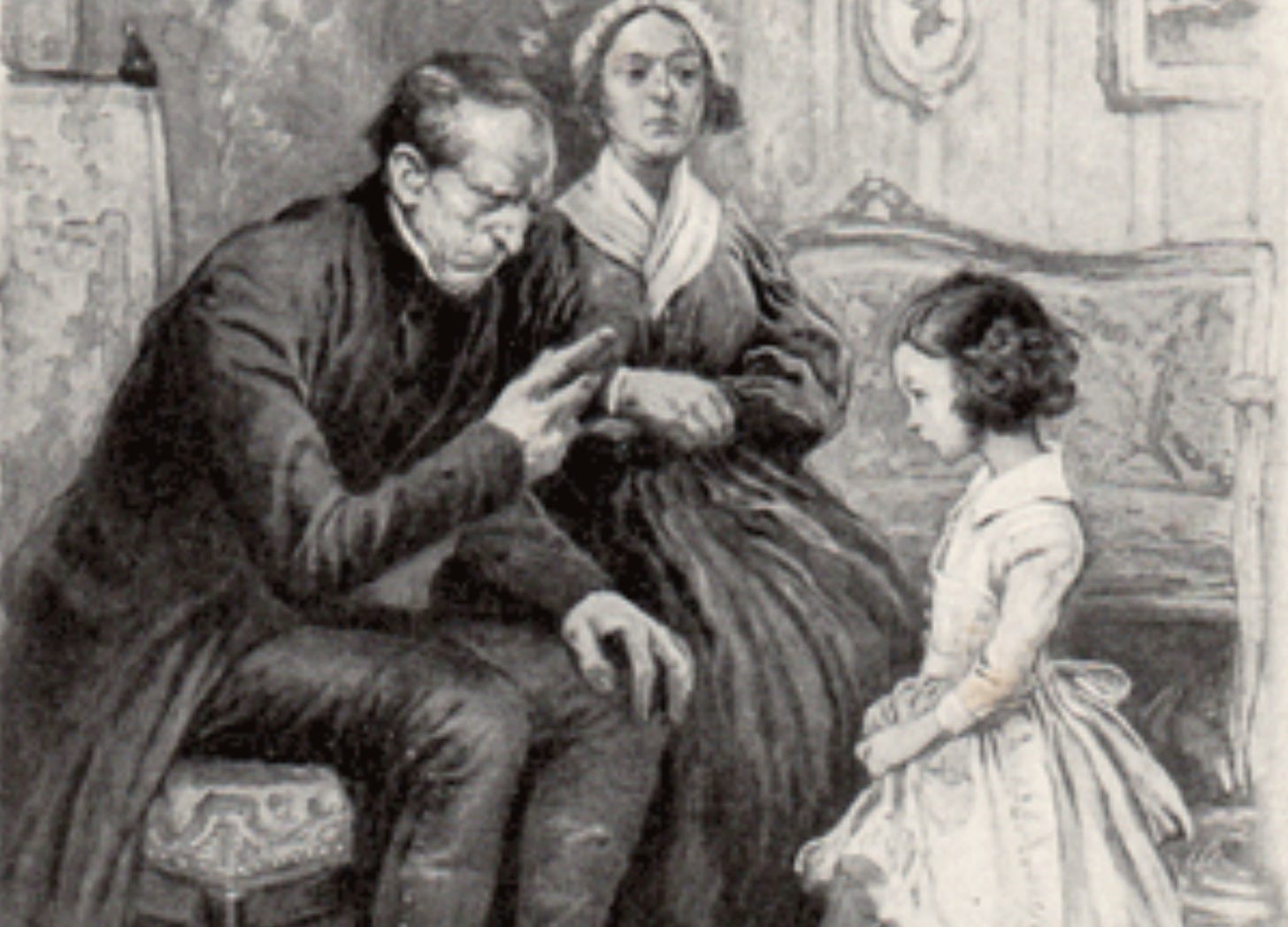
"And should you like to fall into that pit, and to be burning there for ever?"
"No, sir."
"What must you do to avoid it?"
I deliberated a moment; my answer, when it did come, was objectionable: "I must keep in good health, and not die."
—Charlotte Brontë, Jane Eyre (Chapter 4)
Charlotte Brontë plays some sleight of hand in this chapter. Mrs. Reed tells the supervisor of Lowood School, Mr. Brocklehurst, that Jane has, “a tendency to deceit.” Jane is rankled by this and confronts Mrs. Reed after Mr. Brocklehurst leaves, accusing her of neglect, cruelty, and favoritism. When Mrs. Reed demurs, Jane insists, “Deceit is not my fault!” This is all true, and readers tend to applaud Jane for sticking up for herself.
However, in the course of the book, Mrs. Reed’s response to Jane is more telling, “But you are passionate, Jane, that you must allow…” The modern reader sees no problem with passion, but Brontë embeds this comment within a larger discussion about temperance—or rightly ordered passions—throughout Jane Eyre. Mrs. Reed may be wrong about everything else, but she stumbles upon the true struggle in Jane’s soul.
When we meet Jane in Chapter 1, we see an isolated and stifled little girl who finally fights back against her abusive cousin John. Chapter 4’s conversation with Mrs. Reed mirrors that on a larger scale because she confronts a larger authority. Within the scope of the true injustice she experiences as a child, it makes sense that she feels victorious afterward. However, that triumph subsides into “the pang of remorse and the chill of reaction.” The swing from repression to unchecked expression is not the solution.
Chapter 4 Questions
✢ Who is Mr. Brocklehurst? How does Charlotte Brontë develop him as a character in this chapter?
✢ How does Jane confront Mrs. Reed after Mr. Brocklehurst leaves? Evaluate this change in Jane as a character.
✢ How does Jane’s relationship with Bessie develop in this chapter? Why do you think Bessie changes her attitude and behavior?
✢ What do you think school will be like for Jane? Make predictions based on what we know about Lowood School so far.
Teaching Tips
✢ “To this crib I always took my doll; human beings must love something, and, in the dearth of worthier objects of affection, I contrived to find a pleasure in loving and cherishing a faded graven image, shabby as a miniature scarecrow” (emphasis added). Notice where Jane seeks her solace. What does this say about the state of her heart? Where should she turn instead?
✢ Discuss the interview with Mr. Brocklehurst. My students are usually mad—either at Jane’s situation or, more typically, at Brontë for writing “such a depressing book.” Readers can feel like the hope that school offers is dashed when Mrs. Reed gives such a poor account of Jane before sending her away. It is also important to pull out what students can notice about Mr. Brocklehurst as a character and as a Christian.
✢ Jane’s claim to Mrs. Reed, “You think I have no feelings, and that I can do without one bit of love or kindness…” foreshadows a similar exclamation in Chapter 23. Comparing the two situations (when you get there) can be helpful.
✢ In her confrontation with Mrs. Reed, Jane concludes, “I will tell anybody who asks me questions, this exact tale. People think you a good woman, but you are bad, hard-hearted. You are deceitful!” This is ironic, as Jane Eyre is published as an “autobiography,” so in some sense, narrator Jane fulfilled that threat.