

Passion and Patience: Jane Eyre Chapter 6
A Jane Eyre Readalong and Teachalong

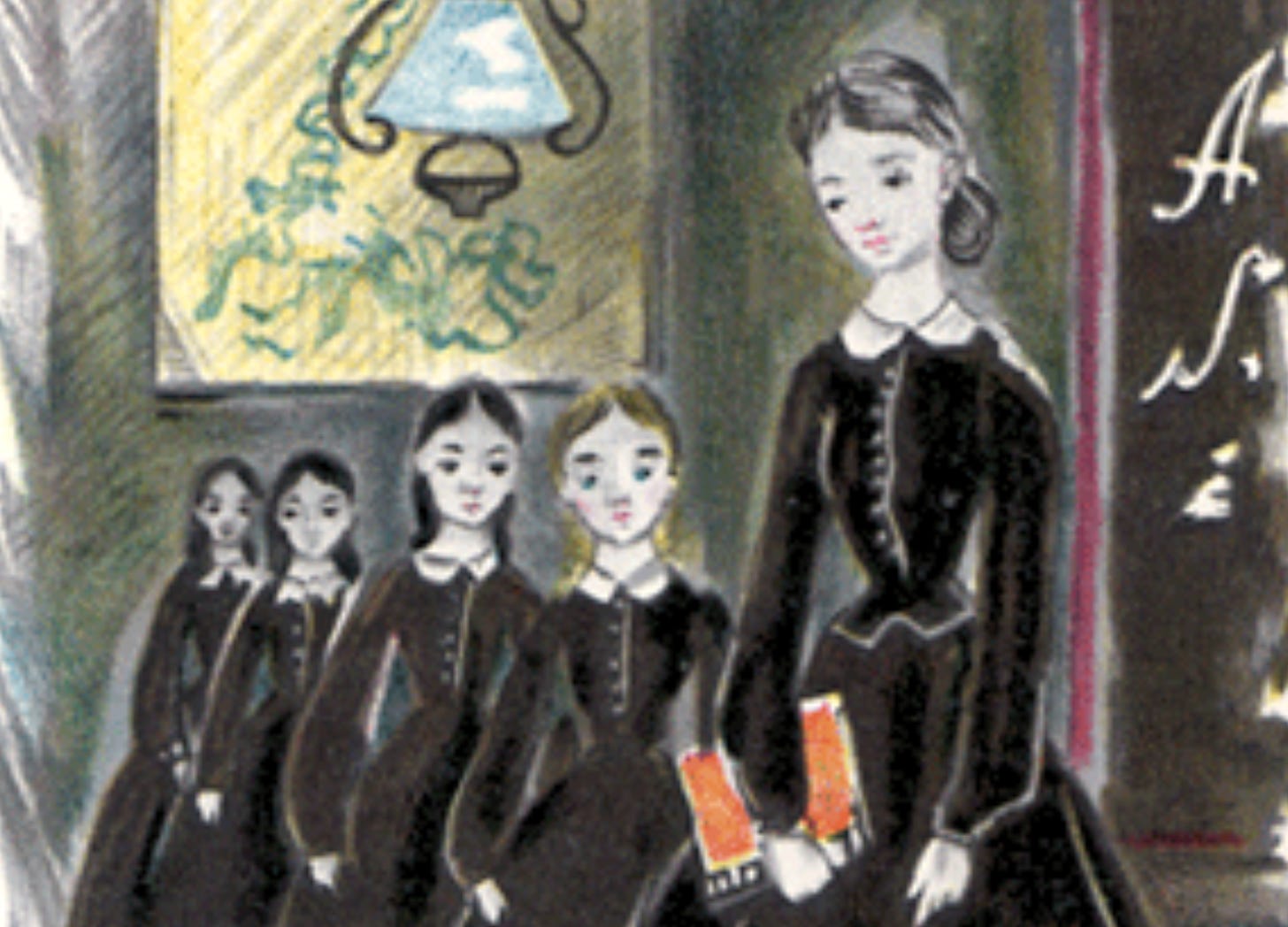
In Chapter 6, Helen Burns pushes back against Jane’s passion. When Jane asks Helen how she can bear punishment that Jane sees as disproportionate, Helen appeals to Scripture and a future life in heaven as reasons to endure. When Jane tells Helen about Mrs. Reed’s treatment, Helen replies:
Would you not be happier if you tried to forget her severity, together with the passionate emotions it excited? Life appears to me too short to be spent in nursing animosity or registering wrongs.
Students sometimes protest that Helen is angelic to the point of being unrealistic. Historically, Charlotte Brontë based Helen on her own sister, Maria. Charlotte’s father, Patrick Brontë, wrote, “Lastly, I asked the oldest [Maria] what was the best mode of spending time; she answered, ‘By laying it out in preparation for a happy eternity.’”1 This is similar to Helen’s Chapter 6 comment, “I live in calm, looking to the end.”
Brontë also told friend and fellow writer, Elizabeth Gaskell, about her sister. Notice that the teacher’s name, Miss Scatcherd, is the same in Jane Eyre and that Maria is criticized as untidy, just like Helen.
Maria had been ill—so ill that it had been necessary to apply a blister to her side, the sore from which was not yet healed. On hearing the rising bell one morning, while in this condition, she said to some of her companions in the dormitory that she did not feel well enough to get up, and wished she might remain in bed. They advised her to do so, but she dared not for fear of the teacher known to us as Miss Scatcherd, who disliked her and seized every opportunity to treat her harshly. She was yet sitting upon the edge of the bed, shivering with cold and slowly drawing on her stockings over her thin feet, when this woman suddenly entered the room and, without waiting for any explanation, seized her by the arm, and with a single movement whirled her into the center of the floor, abusing her at the same time for her untidy habits. She then left the room, and Maria made no reference to the occurrence, except to beg a few of the more indignant girls to be calm. Slowly and painfully she finished dressing and went down to breakfast, only to be punished because she was late.2
Chapter 6 Questions
✢ Jane observes her previous acquaintance, Helen Burns, being reprimanded by one of the teachers. How does she perceive this? Compare Helen’s reaction to Miss Scatchert to Jane’s reaction to her Aunt Reed.
✢ When Jane asks Helen about how she is treated at Lowood, what is Helen’s perspective?
✢ What advice does Helen give Jane about how she should think about her aunt and cousins? Is this good advice?
✢ Evaluate Helen as a character. Why do you think Charlotte Brontë wrote her in this way?
Teaching Tips
✢ Notice that Helen is the first to push back on Jane’s temperament on a heart level. Abbott and Bessie chided Jane for her behavior or her attitude. Helen acknowledges Jane’s treatment as poor but still points out, “What a singularly deep impression her injustice seems to have made on your heart!” She also notes Jane’s “passionate feelings,” which is similar to Mrs. Reed’s judgment that Jane is “passionate” in Chapter 4.
✢ This is a good case study for discussing the difference between just/injust actions and appropriate/inappropriate reactions. Why does Helen focus more on Jane’s reaction to her family than on her family’s treatment?
The Life of Charlotte Brontë, Elizabeth Gaskell
James Parton, Daughters of Genius (1886), emphasis added